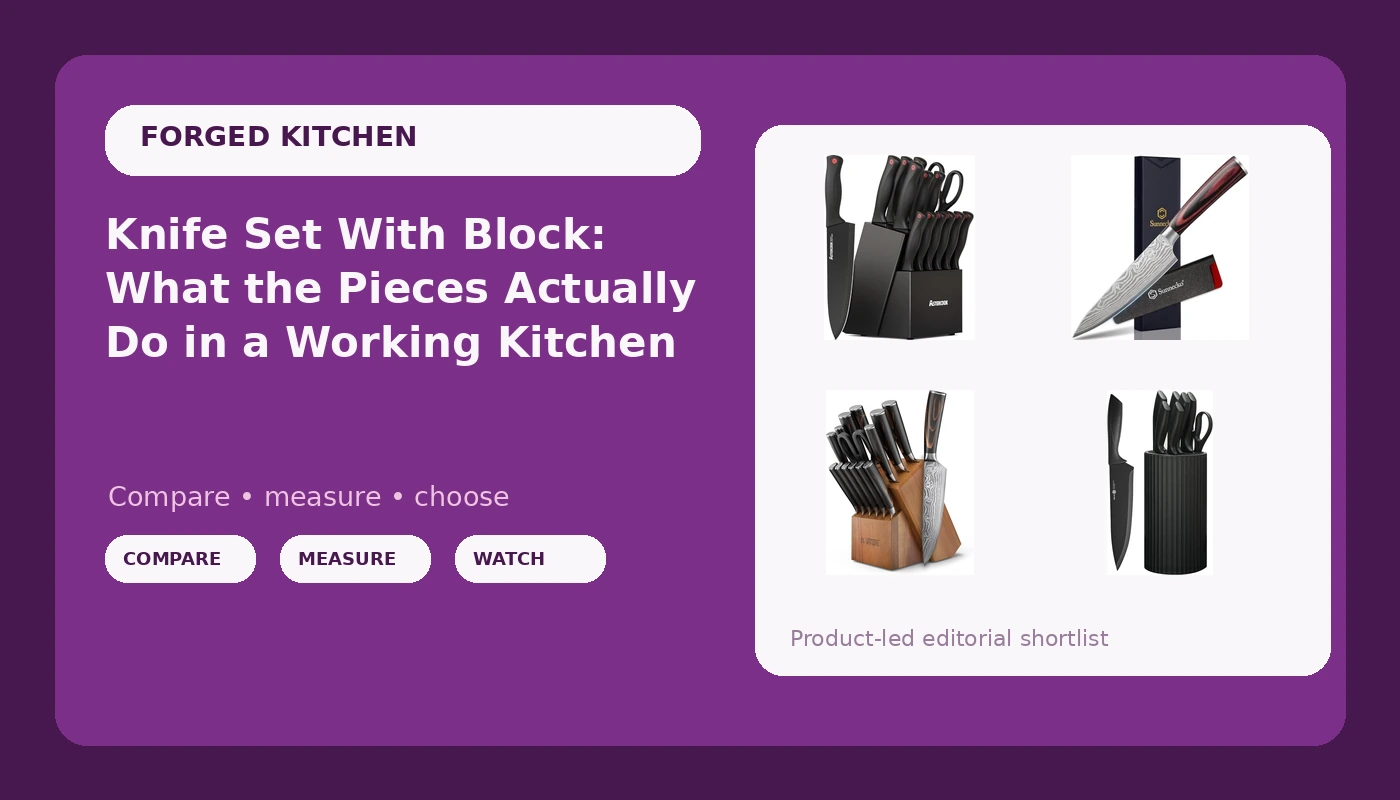
If you have ever stood in an aisle staring at a knife set with block, you already know the problem. Every box promises a complete kitchen, and every box counts its pieces differently. One set calls itself 15 pieces and pads that number with six steak knives. Another calls itself 8 pieces and counts the block itself as one of them. The figure printed on the front of the box is a marketing decision, not a measurement of how well you will actually cook.
I spent sixteen years on the line and four more behind a butcher counter, and the answer never changed: a set is about 80 percent chef's knife. Everything else is support. So the real question is not which box contains the most pieces. It is which set puts a knife you can live with into your hand, and whether you even want a block sitting on your counter in the first place.
Related: How to Hone a Knife Without Rolling the Edge →
Quick answer
Buy for the chef's knife, not the piece count. If you are starting from nothing and want a complete block on the counter, the Astercook 15-piece set with block and sharpener is the most self-contained option here, because storage and maintenance come in the same box. If you already own a block and only need the blade that does most of the work, the Sunnecko 5.5 inch small chef knife is a targeted addition rather than a replacement set. The Yatoshi 15-piece set is the other full-set route, built around high carbon stainless steel and an ergonomic handle. The 8-piece universal block set is the compact choice, and its listing describes it as dishwasher safe. None of these is automatically better than the others. The right pick depends on counter space, how you hold a knife, and whether you want a whole set or one good blade.
Four useful options
| Model | Best fit | What stands out |
|---|---|---|
| Astercook Knife Set for Kitchen with Block and Sharpener 15pcs German | Someone starting from zero who wants a block, a sharpener, and a full lineup in one purchase | 15 pieces with a storage block and a built-in sharpener; German steel as described in the listing |
| Sunnecko 5.5 Inch Small Chef Knife | Cooks who already own a block and want one better blade | 5.5 inch Japanese style blade with a 12-15 degree edge, high carbon stainless steel, and a sheath |
| Yatoshi Professional Kitchen Knife Set, 15 Pieces | Buyers who want a full 15-piece set with a different steel and handle feel | 15 pieces, high carbon stainless steel, ergonomic handle |
| Knife Set, 8-Piece Kitchen Knife Set with Universal Block | Small kitchens, rentals, and anyone who wants a compact set that can go in the dishwasher | 8 pieces with a universal block, anti-rust blades, dishwasher safe per the listing |
The complete starter set: Astercook Knife Set for Kitchen with Block and Sharpener 15pcs German
A set like this solves a logistics problem before it solves a performance problem. You get a block, you get slots for everything, and you get a sharpener that lives with the knives instead of disappearing into a drawer. For a first apartment, a starter kitchen, or a household running on mismatched hand-me-downs, that convenience is real and worth paying for.
The trade-off is that a large piece count spreads the budget across pieces you may never touch. If you cook vegetables and proteins for two people, half of that block will stay dusty. Buy it for the chef's knife and the block, and treat everything else as a bonus rather than a reason to choose it.
The single-knife upgrade: Sunnecko 5.5 Inch Small Chef Knife
The 5.5 inch length is the interesting part. It is shorter than a standard 8 inch chef's knife, which makes it nimble for shallots, herbs, trimming, and any task where a big blade feels like overkill. It also suits smaller hands and cramped cutting boards, which is more of a factor than most buyers admit until they have spent an hour with a knife that fights them.
A Japanese style profile with a 12-15 degree edge is thinner behind the edge than a typical German pattern, and that geometry is what makes produce feel effortless. The same geometry is the trade-off: a thin, steep edge is not the tool for hacking through chicken bones or frozen food. The included sheath also means you can store it outside a block, which is exactly how a lot of cooks keep the one knife they actually reach for.
The full-set alternative: Yatoshi Professional Kitchen Knife Set, 15 Pieces
Two 15-piece sets in one comparison can look redundant until you think about what you want in your hand. Handle shape and balance decide whether you reach for a knife or avoid it, and this set is described with an ergonomic handle and high carbon stainless steel. If you want a full block lineup and the other set's steel or handle does not suit you, this is the second route to the same destination.
The same caution applies here as anywhere else in this category. A 15-piece count almost always includes steak knives, shears, a peeler, and the block itself, so judge the chef's knife first and everything else second. Steak knives are the easiest thing in the world for a manufacturer to add and the least likely to change how you cook.
The compact block set: Knife Set, 8-Piece Kitchen Knife Set with Universal Block
This is the set for a small kitchen, a rental, a cabin, or a second setup where you do not want to think about maintenance. The listing describes anti-rust blades and dishwasher-safe construction, which is uncommon in this category and genuinely useful if you know you are not going to hand wash anything.
My honest position, though: even when a manufacturer says dishwasher safe, heat and detergent are hard on an edge, and a knife that goes through a drying cycle every night will need attention sooner. If the choice is between a dishwasher-safe set and no decent knife at all, take the set. Just know what you are trading.
Prices and availability may change. Product images, names, and retailer links must be matched by verified ASIN. Do not state a current price, rating, stock status, or measured result without current evidence.
What a 15-piece set actually counts
Here is the arithmetic nobody prints on the box. A typical 15-piece block set contains an 8 inch chef's knife, a santoku or slicer, a bread knife, a utility knife, a paring knife, six steak knives, a pair of kitchen shears, a peeler, a honing steel, and the block itself. That is 15. Four of those pieces are the ones you will use for actual prep work, and the block counts as a piece.
That does not make a 15-piece set a bad purchase. It makes it a purchase you should judge differently. Ask what the chef's knife is, what size it is, and whether the handle fits your grip. Then ask how many of the remaining slots you will fill in a normal week. If the answer is three, a smaller set or a single good knife plus a magnetic strip may serve you better.
Two other details are worth checking before you buy. First, a honing steel is not a sharpener. It realigns an edge that has rolled over; it does not cut new steel. Sets that include a steel but no stone still expect you to own or buy a sharpener eventually. Second, a built-in block sharpener is convenient but tends to remove more metal than a stone does, so use it sparingly rather than every time you cook.
Steel, edge angle, and what "German" and "Japanese" mean on a box
German style knives are generally made from softer, tougher steel with a thicker edge, sharpened somewhere around 15 to 20 degrees per side. That toughness is why they tolerate bones, squash, and a certain amount of user error. They also lose a razor edge faster, which is why honing before use became a habit in European kitchens.
Japanese style knives, like the 12-15 degree edge described on the Sunnecko, are typically harder and thinner behind the edge. They feel sharper on produce because they are sharper, and they hold that edge longer. The cost is brittleness: hard, thin steel chips rather than dents, so it does not belong near bones, frozen food, or a careless sink.
Hardness itself is measured on the Rockwell scale, usually written as HRC. Higher numbers hold an edge longer but take more effort to sharpen and are more prone to chipping. Lower numbers sharpen easily but need honing more often. Neither is better; they are different maintenance contracts.
Two structural details matter as much as steel. Full tang means the steel runs the full length of the handle, usually visible as a strip between the handle scales, and it is the difference between a knife and a toy. The bolster is the collar between blade and handle; it protects your fingers and adds weight, but a thick bolster makes it harder to sharpen the heel of the blade on a stone. Neither detail is confirmed by a piece count, so read the description before you decide.
- Measure your counter and your cutting board before you buy anything. A block takes up more room than it looks like it will.
- Pick the chef's knife size you will actually use. An 8 inch blade suits most cooks; a 5.5 inch blade suits smaller hands, smaller boards, and detail work.
- Decide whether you want a set or a single knife. If you already own a block, you probably want the knife.
- Match steel and edge angle to what you cook. Lots of produce favors a thinner Japanese style edge; bones and squash favor a tougher German style edge.
- Budget for maintenance in the same purchase. A honing steel and a sharpening option belong with the knife, not three years later.
Keeping a block set sharp in a real kitchen
- Hone before you cook, sharpen on a schedule. Honing realigns, sharpening cuts. You need both, and neither one replaces the other.
- Hand wash and dry immediately, even on a set the listing calls dishwasher safe. Detergent and heat are unkind to edges, and moisture left on a blade is what rusts it.
- Store knives so the edge never touches anything hard. A magnetic strip or a slot block that holds the blade by the spine will keep an edge longer than a block that pinches it on insertion.
- Never cut on glass, stone, or bamboo. A plastic or wood board protects the edge more than any steel claim on a box ever will.
- Keep the bread knife for bread. A serrated knife cannot be honed back into shape easily, so save it for crusts instead of using it as a general slicer.
Which option should you choose?
Choose the Astercook Knife Set for Kitchen with Block and Sharpener 15pcs German when you are outfitting a kitchen from scratch and want the block, the knives, and the sharpener handled in one purchase. Choose the Sunnecko 5.5 Inch Small Chef Knife when you already have storage sorted and want one sharper, more compact blade for everyday prep. Choose the Yatoshi Professional Kitchen Knife Set, 15 Pieces when you want a full 15-piece lineup and prefer the handle and steel this set describes. Choose the Knife Set, 8-Piece Kitchen Knife Set with Universal Block when space is tight or when you want a compact set the listing describes as dishwasher safe.
One caveat worth stating plainly: these descriptions come from the manufacturer listings, not from a laboratory. Piece counts and materials are easy to verify on a product page; balance, handle comfort, and how an edge holds up over months are personal and depend on how you cook and how you maintain the blade.
The bottom line
A knife set with block is a storage decision and a starter decision more than a performance decision. The block keeps your knives where you can find them, and the set gets you cooking the day it arrives. But the piece count is the least useful number on the box. Look at the chef's knife, the steel, the edge angle, and the handle, then decide whether you want a full block or one blade you will actually maintain. Whatever you choose, add a honing steel and a sharpening plan to the same order, because sharpness is a habit you keep, not a feature you buy.