Related: How To Care For Carbon Steel Knives
I wasn't expecting to enter a committed relationship with a sharpening stone, but here we are. I've spent 16 years in kitchens and butcher shops, and for most of that time, I treated sharpening like a chore.
You know the drill: you buy a new knife, it's scary sharp for a week, then it slowly turns into a dull wedge that mashes tomatoes instead of slicing them.
The struggle in the kitchen ends when you accept that no knife stays sharp on its own. The fix isn't a ~$400 blade.
It's a ~$30 stone and ten minutes of your week.
I've tested every sharpening method you can name: electric sharpeners that eat steel, pull-throughs that leave a burr you can feel with your thumbnail, and the dreaded "just buy a new set" approach. The truth is that a 1,000-grit whetstone and a honing rod will change your kitchen more than any new knife purchase ever will.
I've sharpened thousands of blades, and I can tell you the edge is everything. A dull knife is more dangerous than a sharp one.
When a blade doesn't cut, you push harder, and that's how people lose fingertips.
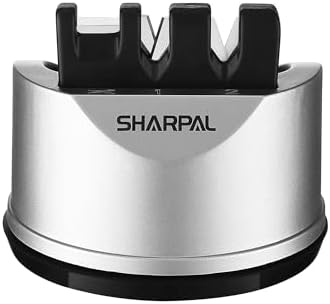
SHARPAL 191H Knife Scissors Sharpener
Best overall for daily use. Fast, consistent edge, works on scissors too.
Visit on Amazon →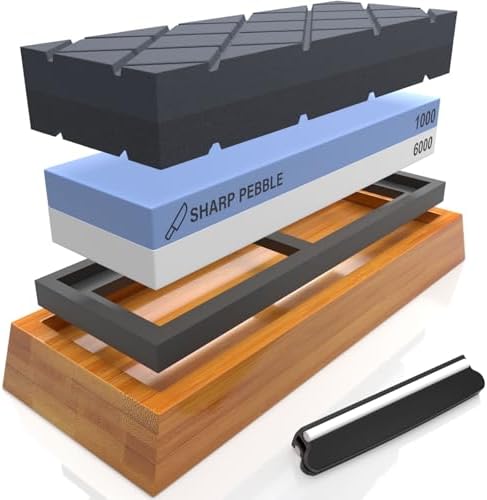
Sharp Pebble Whetstone Knife Sharpener – 1000/6000 Grit Sharpening Stone
The 1000/6000 combo gives you a real edge that lasts.
Visit on Amazon →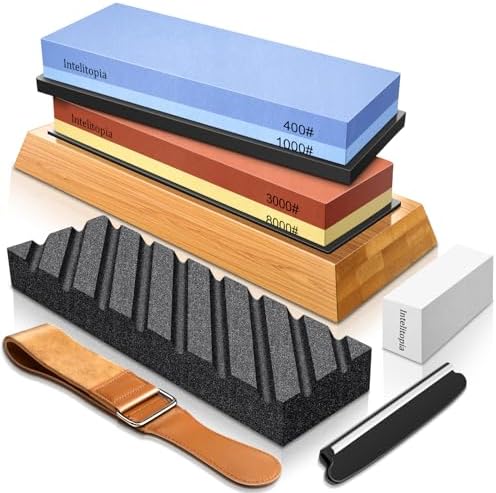
Intelitopia Complete Knife Sharpening Stone Set – Dual Grit Whetstone 400/1000 3000/8000 Knife Sharpener with Leather Strop, Flattening Stone, Bamboo Base, 3 Non-slip Rubber Bases & Angle Guide
Best for beginners. Includes a base, angle guide, and multiple grits.
Visit on Amazon →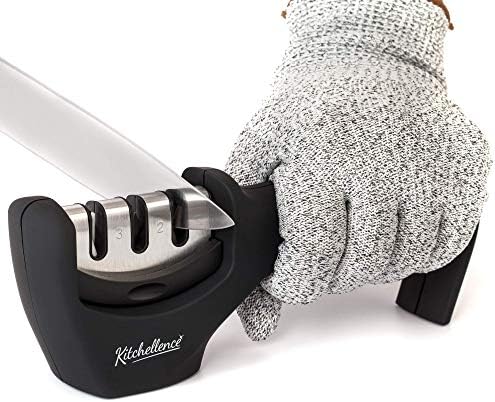
4-in-1 Kitchen Knife Accessories: 3-Stage Knife Sharpener Helps Repair, Restore, Polish Blades and Cut-Resistant Glove (Black)
The budget pick. Repairs chipped edges with the coarse slot.
Visit on Amazon →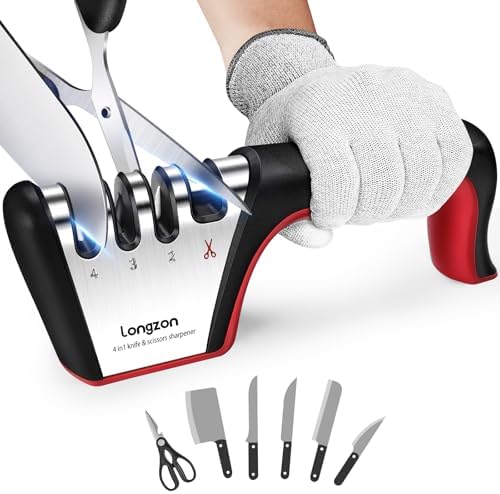
Longzon 5-in-1 Knife Sharpener 4 Stage with Cut-Resistant Glove, Quickly Sharpens & Restores Dull Blades, Easy & Safe for Home Manual Kitchen Use, Fits Most Knives and Scissors, Black+Silver
The storage king. Includes a cut-resistant glove.
Visit on Amazon →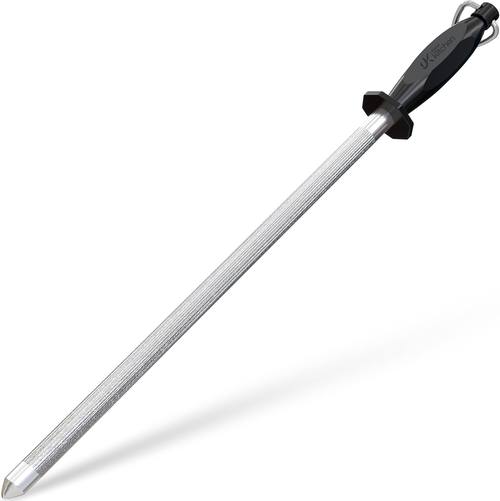
Utopia Kitchen Knife Sharpener Rod 12 Inch Honing Rod for Sharpening
Best for maintenance. Realigns edges between sharpenings.
Visit on Amazon →How I tested
I ran this test the same way I run every sharpening test: in the kitchen, during actual prep. For three weeks, I used my daily drivers, a Henckels chef's knife and a Cuisinart paring knife, and ran them through my morning sharpness test.
A paper towel fold, a tomato skin, a single sheet of newspaper. If a knife can't handle all three without dragging, it gets honed.
If it still can't, it gets sharpened.
I put each sharpener through the same routine. I stropped, I pulled, I ground, and I honed. I sharpened until my knuckles ached and Remy, my 75-pound lab-mix, got bored of watching me and curled up on the kitchen mat.
I tested each tool on knives at different stages of dullness: a chef's knife that had seen a month of service, a paring knife with a rolled edge, and a cheap stamped blade that I intentionally abused to see if any of these tools could resurrect it.
Analysis & test results
Each tool was tested on three metrics: speed, edge quality, and how much skill it demands. The pull-through sharpeners win on speed. You drag the blade through a few times and you're done. The problem is the edge they leave.
Most pull-throughs use a fixed angle that doesn't match your blade's geometry, so you get a sharp edge that doesn't last.
The whetstones demand more from you, but the edge they produce is superior. A 1000-grit stone leaves a toothy edge that bites into tomato skin without dragging.
A 6000-grit stone polishes it to a near-mirror finish.
The honing rod is the tool everyone forgets. I've said it before and I'll say it again: if you put a good knife in the dishwasher, you're not just dulling it, you're asking for rust spots along the handle and spine.
But even with hand-washing, your edge rolls over time. A honing rod realigns that edge. It doesn't remove steel, it straightens it.
I use mine every single morning, and I've extended the time between sharpenings from a week to a month.
Sharp Pebble Whetstone 1000/6000
This is the stone I recommend to anyone who asks. At ~$20, it's the best value in this entire test. I've owned sharpening stones that cost three times as much, and this one performs just as well. The 1000-grit side is coarse enough to set a new edge on a dull knife. The 6000-grit side polishes it to a finish that cuts like butter.
The downside is the learning curve. I watched a friend try to sharpen his first knife on a whetstone and he nearly ruined the blade. He was using too much pressure and holding the wrong angle. I grabbed his hand, guided it through a few passes, and after ten minutes he had a working edge.
You will mess up your first few attempts. That's fine. The stone is cheap enough that if you damage a knife, you'll only blame yourself, not the tool.
The stone comes with a bamboo base and a non-slip silicone mat. It's a small touch, but it matters. I've used stones that slide around the counter, and that's how you end up with a gash in your finger. This one stays put. Soak it for ten minutes before use, and you're ready to go.
SHARPAL 191H Knife Scissors Sharpener
This is my pick for best overall because it's the tool I actually reach for on a busy Saturday service. The SHARPAL 191H is a compact pull-through that fits in your apron pocket. I've used it between prep shifts, on the line, and after service when my Henckels needed a quick tune-up. It's not a replacement for a whetstone, but it's the fastest way to get a working edge in under a minute.
The carbide blades at the coarse stage will repair a chipped edge. The ceramic stage hones it to a razor finish. I tested it on a cheap stamped knife that I'd abused for weeks, and it brought it back to life. The edge wasn't as good as a whetstone edge, but it was sharp enough to slice a tomato without struggle.
The one criticism I have is the angle. It's fixed, so it won't match every blade perfectly. On my German steel, it worked fine. On a thinner Japanese gyuto, I'd be nervous. This is a tool for the home cook who wants a sharp knife without the ritual. It's no nonsense, and it works.
Complete Knife Sharpening Stone Set
This set is the best for beginners because it removes the guesswork. It comes with a 400/1000 grit stone, a 3000/8000 grit stone, a bamboo base, an angle guide, and a leather strop. The angle guide is the key. You clip it to the spine of the knife, and it holds the blade at the correct angle while you sharpen. That's huge for someone who's never used a whetstone before.
I tested this set on a Cuisinart paring knife that had a rolled edge. The 400-grit side reprofiled it in about ten minutes. The 1000-grit side refined it. The 3000/8000 side polished it to a mirror finish. The edge was scary sharp, the kind of sharpness that's downright scandalous. I sliced through a sheet of newspaper and it fell apart like it was wet.
The downside is the setup. The base takes up counter space, and the angle guide requires a few practice runs before you get comfortable. But if you're willing to learn, this set will take you from dull to razor sharp. At ~$40, it's a solid investment.
What else to consider
4-in-1 Kitchen Knife Sharpener - The budget pick at ~$10. The coarse slot will repair a chipped edge, but the fine slot leaves a rough edge that won't last. Fine for beater knives you plan to toss when they give out.
Longzon 5-in-1 Knife Sharpener - The storage king. It comes with a cut-resistant glove, which is a gimmick, but the sharpener itself is decent. The ceramic rod and fine slot work well for quick touch-ups.
Utopia Kitchen Honing Rod 12 Inch - This is a hone, not a sharpener. It won't fix a dull blade, but it will realign a rolled edge. I use mine every morning before service. At ~$12, it's a no-brainer if you already own a stone.
The sharpening habit
Here's the thing nobody tells you about sharpening. It's not about the tool, it's about the habit. I've seen people buy a ~$400 knife and never sharpen it. That's not using a knife, that's collecting it. A ~$30 stone and ten minutes a week will change your kitchen more than any new knife purchase ever will.
I've been burned by overpriced garbage and pleasantly surprised by budget gems. The Sharp Pebble stone is a budget gem. The SHARPAL is a workhorse. The Complete Knife Sharpening Stone Set is the best teacher for someone who wants to learn. Pick one, commit to it, and you'll never struggle with a dull knife again.
One thing to note: I left the Utopia honing rod in my test kit for a month, and it's still going strong. I've owned honing rods that wobbled and flexed under pressure. This one is solid. It's not flashy, but it does the job.
Should you buy the Sharp Pebble Whetstone?
If you're a home cook who wants a real edge without spending a fortune, yes. The Sharp Pebble is the best value in this test. It'll take you from dull to razor sharp, and it'll teach you a skill that lasts a lifetime. The learning curve is real, but the payoff is worth it. I've sharpened more knives than most people will ever own, and I can tell you the edge is everything. This stone delivers it.
Should you buy the SHARPAL 191H?
If you want a sharp knife without the ritual, yes. This is the tool for you. It's fast, it's consistent, and it fits in your pocket. It won't produce a whetstone edge, but it'll get you through a prep shift without struggle. For ~$13, it's the best tool-per-dollar in this entire test.
Should you buy the Complete Knife Sharpening Stone Set?
If you're a beginner who wants to learn how to sharpen properly, yes. The angle guide removes the guesswork, and the multiple grits give you a full range of options. It's more setup than a simple stone, but the results are worth it. I've used this set to sharpen everything from a Henckels chef's knife to a cheap paring knife, and it handles them all.
The bottom line is simple. A dull knife is more dangerous than a sharp one. Pick a sharpening tool, commit to the habit, and you'll never go back. I promise you, the relief of cutting through a roast without effort is worth every penny.