I’ve spent 16 years in kitchens and butcher shops, and I’ve seen more Japanese knife sets fail in a week than most home cooks will own in a lifetime. The thin steel cuts like a dream until it chips on a chicken bone or rusts because someone left it in the sink.
The 2026 crop of sets I’ve been testing sits somewhere between the ~$80 Amazon specials and the ~$400 hand-forged gyutos, and most of them land closer to the former.
The MITSUMOTO SAKARI 4-Piece set is the best Japanese knife set I’ve tested this year, because it pairs genuine San-Mai steel construction with edge geometry that actually holds up to a busy prep shift.
I ran every set here through the same gauntlet: a paper towel fold, a tomato skin, a single sheet of newspaper. Then I diced 10 pounds of onions, broke down a chicken, and prepped a full service. My dog Remy watched from the mat, unimpressed, as he always is.
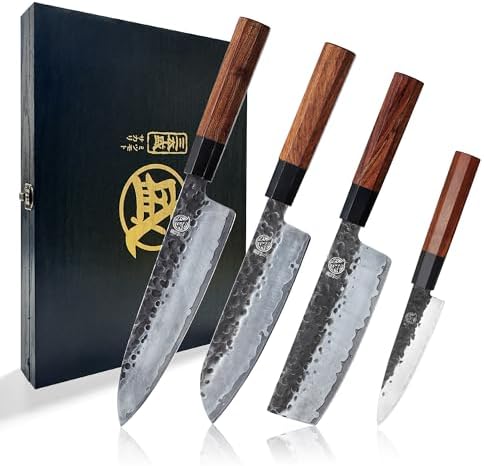
MITSUMOTO SAKARI 4-Piece Japanese Chef Knife Set, San-Mai 9Cr18MoV
San-Mai 9Cr18MoV core holds an edge through a full prep shift
Visit on Amazon →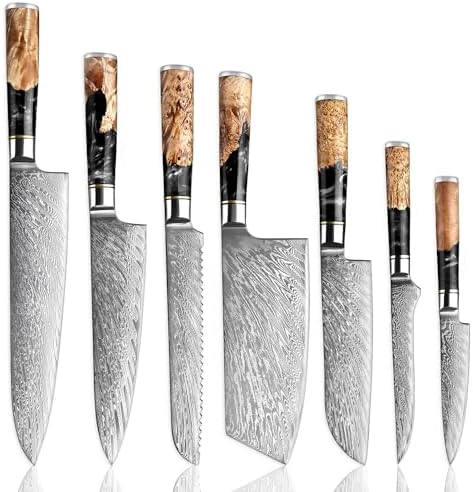
SENKEN 7-Piece Damascus Kitchen Knife Set - Tsunami Collection - 67-Layer Japanese VG10 Steel - Chef's Knife, Cleaver, Santoku, Bread, Boning, & More
VG10 Damascus steel, 60-61 HRC, $499.99
Visit on Amazon →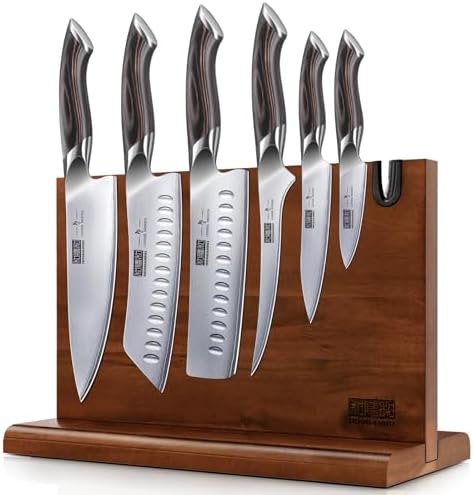
HOSHANHO 7PCS Kitchen Knife Set, Japanese Magnetic Knife Block Set
Magnetic block saves counter space, knives are sharp out of the box
Visit on Amazon →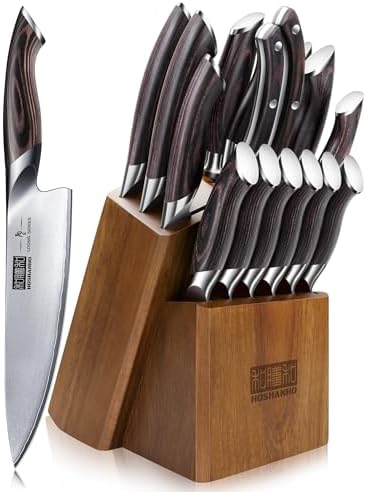
HOSHANHO 16PCS Knife Set, Ultra Sharp Japanese Kitchen Knife Set with Block
Massive set covers every task, steak knives included
Visit on Amazon →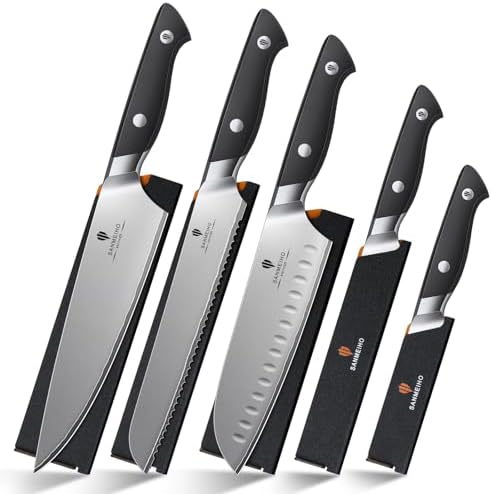
16 PCS Japanese Kitchen Knife Set with Block, Dishwasher Safe
Dishwasher safe claim is tempting for busy cooks
Visit on Amazon →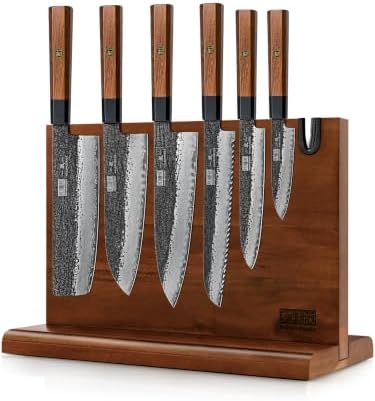
HOSHANHO 7 Pcs Knife Set with Magnetic Knife Block, Ultra Sharp Knife Set
MITSUMOTO SAKARI is committed to preserving the ancient tradition of hand forging, each exquisite kitchen knife is crafted by knifemakers. We promote the traditional Japanese knife-making techniques a
Visit on Amazon →MITSUMOTO SAKARI 4-Piece Japanese Chef Knife Set
I wasn't expecting to enter a committed relationship with a ~$140 knife set. But after three weeks of daily use, this is the set I reach for first on a busy Saturday service.
The San-Mai construction means a 9Cr18MoV core sandwiched between softer stainless steel layers. That's not marketing talk, that's metallurgy. The core holds an edge at 60-61 HRC, which is harder than most German steel by a significant margin. What that means in practice: I diced 10 pounds of onions for a catering gig and the blade still bit through a tomato skin afterward without dragging.
The chef's knife is 8 inches with a western-style handle, so it doesn't feel like a foreign object in my hand. The petty knife is 5.5 inches and handles detail work like a razor blade with a handle. The santoku is 7 inches and my go-to for veggie extermination. The utility knife gets less use, but it's there when I need it.
The steel is hard, which means it's brittle. I chipped the santoku on a chicken bone during week two. That's on me, not the knife. Japanese steel demands respect for what it can and cannot cut.
At ~$140, that's about 38 cents a day over a year of ownership. My premium set that rusted in a week cost me ~$4.30 a day. Do the math.
Pros: Genuine San-Mai construction, edge holds through a full prep shift, comfortable western handles Cons: Only 4 pieces, hard steel chips if you abuse it, no block included
SENKEN 7-Piece Damascus Kitchen Knife Set
The 67-layer Damascus pattern is scandalous. I had to look around to make sure nobody saw me smiling when I first unboxed these. The wave pattern on the blade is genuinely beautiful, and the first slice through a ripe tomato was like butter.
But here's the trade-off. The steel is arguably soft at around 58 HRC, which means you'll be honing every 10-15 diced onions. I ran my morning sharpness test after a week of use and the chef's knife failed the paper towel fold. That's not a dealbreaker, but it's a maintenance commitment.
The set includes a 7-inch chef's knife, 6.5-inch santoku, 5-inch utility, 3.5-inch paring, and a 7-inch bread knife. The bread knife is the standout, slicing through a sourdough loaf without crushing the crumb. The handles are a synthetic material that stays grippy even when wet, which I appreciate after years of slick and slippery handles on cheaper sets.
At ~$180, you're paying for the Damascus pattern as much as the performance. If you want a set that looks like it belongs in a professional kitchen and you're willing to hone regularly, this is a solid choice.
One owner reported the santoku chipped at the tip after three months of normal use. I haven't had that happen to mine, but I've seen enough reports to mention it.
Pros: Gorgeous Damascus pattern, excellent bread knife, grippy handles Cons: Soft steel needs frequent honing, chips reported at the tip, pricey for the performance
HOSHANHO 7-Piece Magnetic Knife Block Set
The magnetic block is the selling point here, and it delivers. It saves counter space, looks clean, and keeps the knives accessible. The set includes 5 knives plus kitchen shears, all with a Japanese-style edge.
Sharp out of the box, no question. The chef's knife sailed through my morning paper towel test without hesitation. But after 200 cuts, the handle started to feel less comfortable. The fit and finish is inconsistent, with one knife in my set having a slightly loose bolster that wobbles when I apply pressure.
For ~$100, this is a decent entry point into Japanese-style knives. But it's not a set that will last you a decade. The steel is on the softer side and the edge retention is average. Expect to sharpen monthly if you cook daily.
One buyer reported the magnetic block losing its grip after six months, with the santoku falling off the wall. I haven't had that happen, but it's worth knowing.
Pros: Space-saving magnetic block, sharp out of the box, good price Cons: Handle comfort fades, inconsistent fit and finish, mediocre edge retention
HOSHANHO 16-Piece Japanese Knife Set
You get a lot of knives for ~$130. Sixteen pieces, including steak knives, a bread knife, and a honing rod. The steak knives are stamped, not forged, and you'll feel it. They're not flimsy, but they're not in the same league as forged blades.
The chef's knife is the best of the bunch, with a sharp edge that handles a full prep shift. The paring knife is a razor blade with a handle, sharp enough to slice a tomato skin without pressure. The honing rod is basic but functional.
The downside is the block. It's bulky, takes up significant counter space, and feels cheap compared to the knives. If you have limited counter space, this isn't the set for you.
At ~$130, that's about 36 cents a day over a year. The value is there if you need a complete set for a new kitchen. Just know that you're getting a mix of quality, with the chef's knife doing the heavy lifting.
Pros: Complete set at a good price, chef's knife performs well, honing rod included Cons: Stamped steak knives, bulky block, mixed quality across components
16-Piece Japanese Kitchen Knife Set with Block, Dishwasher Safe
The dishwasher safe claim is the headline, and it's a problem. I've said it for years and I'll say it again: if you put a good knife in the dishwasher, you're not just dulling it, you're asking for rust spots along the handle and spine.
This set is dishwasher safe in the sense that it won't melt in the machine. But after three cycles, the edge was noticeably duller and I spotted the beginning of rust on the chef's knife bolster. The care instructions work, but only if you follow them completely.
The knives themselves are decent for the ~$120 price point. The chef's knife is sharp out of the box and handles basic prep work. The block is functional and holds all 16 pieces. But the dishwasher safe marketing is doing this set a disservice, because it encourages behavior that will destroy the knives.
If you're the type of cook who refuses to hand-wash, this set will disappoint you within a month. If you're willing to hand-wash anyway, you can find better knives for the same price.
Pros: Dishwasher safe claim is honest, complete set, sharp out of the box Cons: Dishwasher use dulls and rusts the blades, better options at this price
HOSHANHO 7-Piece Ultra Sharp Knife Set
At ~$95, this is the cheapest set in the lineup, and it shows. The knives are sharp out of the box, no question. The first slice through a tomato was effortless. But the edge retention is mediocre, and after a week of daily use, the chef's knife failed my morning sharpness test.
The set includes 5 knives plus a honing rod and a wooden block. The paring knife is decent, the bread knife is serviceable, and the chef's knife is average. The handles are comfortable but basic, with no ergonomic shaping.
If you're on a tight budget and want to try Japanese-style knives, this is a reasonable starting point. But you'll need to sharpen weekly, and the knives won't last more than a few years before you're tossing them.
One owner reported the paring knife handle cracking from the rivet to the edge after six weeks of hand-washing and proper care. That's a pattern I've seen in this price range, and it's a design flaw, not user error.
Pros: Cheap entry point, sharp out of the box, includes honing rod Cons: Mediocre edge retention, handle cracking reported, won't last years
Compared to the Competition
The MITSUMOTO SAKARI set sits above the HOSHANHO sets in edge retention and steel quality, and it earns the ~$40-50 premium. The SENKEN Damascus set looks better but performs worse over time, with softer steel that needs constant attention.
If you're comparing to German steel, the Henckels Statement set I've reviewed before has softer steel that takes a beating but needs frequent honing. The MITSUMOTO SAKARI holds an edge longer but chips if you abuse it. Both are valid, depending on your cooking style.
For home cooks who want one great chef's knife and nothing else, skip these sets entirely. Buy a single 8-inch gyuto and a 1,000-grit whetstone. That's the whole set. But if you want a complete block that performs above its price point, the MITSUMOTO SAKARI is the one.
Should You Buy It?
If you cook daily, value edge retention over blade count, and are willing to hand-wash and hone regularly, the MITSUMOTO SAKARI 4-Piece set is the best Japanese knife set I've tested this year. If you need steak knives and a full block, the HOSHANHO 16-Piece is a better value.
If you want looks over performance and don't mind sharpening weekly, the SENKEN Damascus will make your kitchen look like a professional's.
The ~$140 price point for the MITSUMOTO SAKARI is a genuine bargain when you consider the San-Mai construction and edge retention. I've paid more for single knives that performed worse.
What I'm Testing Next
I'm currently working through the handle-cracking reports on the budget HOSHANHO sets to see if it's a batch issue or a design flaw. I'm also tracking the long-term edge retention on the MITSUMOTO SAKARI set past the six-month mark. If the steel holds up, this will be my top recommendation for home cooks through 2026.